
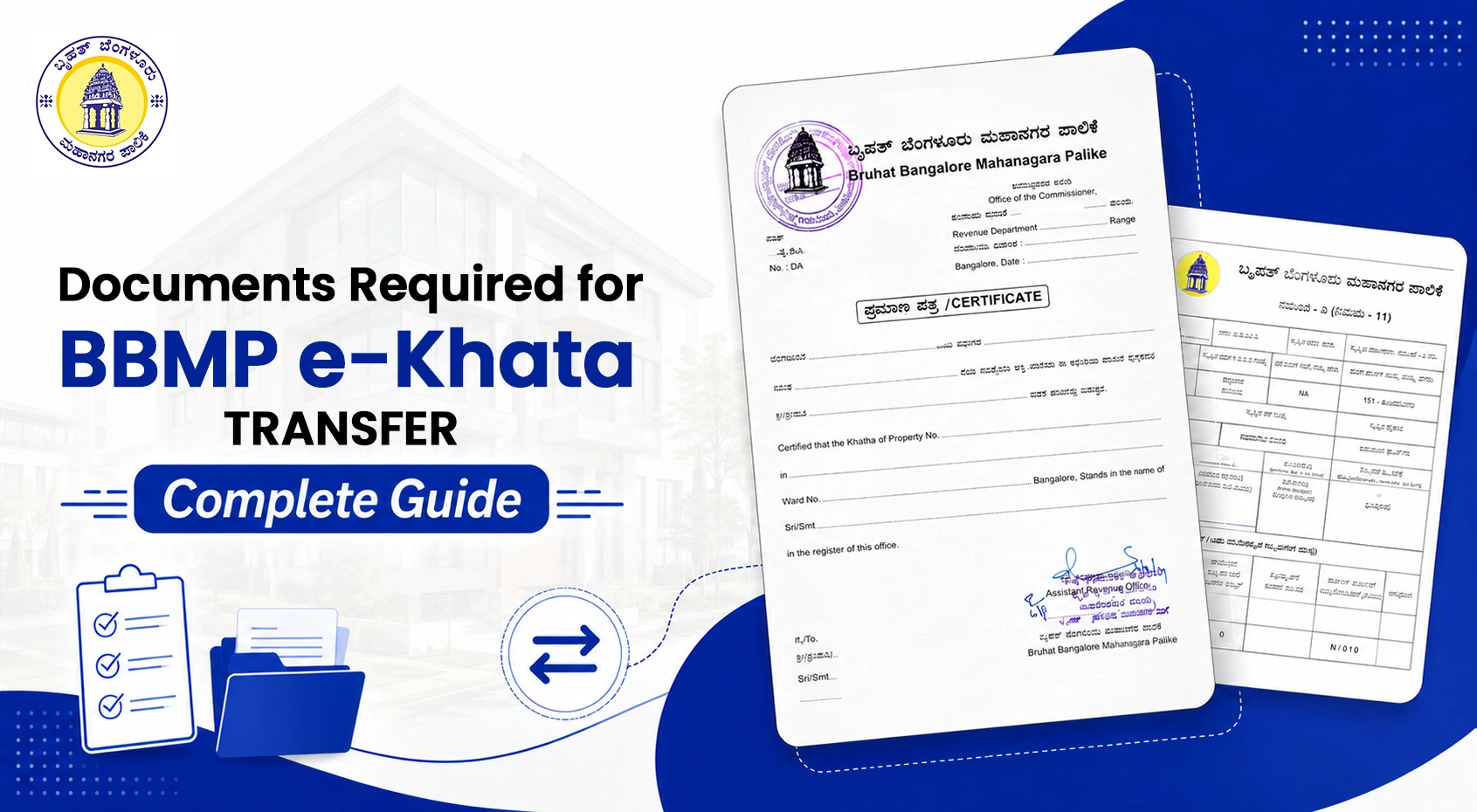
e-Khata transfer in Karnataka is an important step after buying, inheriting, receiving, or transferring a property. It updates the municipal or local body records with the new owner’s name and propaerty details.
Many buyers think that property registration is the final step. But after registration, the khata record also needs to be updated. Without proper khata transfer, the new owner may face issues while paying property tax, selling the property, applying for building plan approval, taking a home loan, or updating property records.
In Bangalore, BBMP e-Khata and e-Aasthi records have become especially important because property documentation is becoming more digital. In other parts of Karnataka, the process may involve city corporations, municipalities, town panchayats, gram panchayats, or e-Swathu records depending on the property location.
This blog explains the required documents for e-Khata transfer in Karnataka, special document needs for different transfer cases, and common mistakes to avoid during e-Khata transfer in Karnataka.
What is e-Khata in Bangalore?
The term “e-Khata” in Bangalore refers to the online representation of the existing Khata document issued by BBMP for recording information about the property. It proves that a certain property is registered officially.Due to bbmp e khata registration, information such as the owner of the property, its location, as well as its tax record, is available in the online database. Thus, this system can be regarded as one of the parts of the online khata registration process in Bangalore.
What Is e-Khata Transfer in Karnataka?
e-Khata transfer means updating the property khata record from the previous owner’s name to the new owner’s name through a digital or local authority process.
It is usually required after:
|
Sale of property |
Gift deed |
Release deed |
|
Partition deed |
Inheritance |
Will or succession |
|
Builder-to-buyer transfer |
Family settlement |
Change in ownership record |
e-Khata is not the same as the sale deed. The sale deed proves ownership transfer through registration. e-Khata updates the municipal or local property record for tax and civic purposes.
Why e-Khata Transfer Is Important
e-Khata transfer is important because it helps keep property records updated with the correct owner name and details.
It is useful for:
|
Property tax payment |
Future property sale |
Bank loan processing |
|
Ownership record update |
Building plan approval |
Property due diligence |
|
Mutation record update |
Avoiding future buyer objections |
Utility connection support |
A registered sale deed is important, but buyers should not ignore khata transfer after registration.
Also Read: How to Apply for Online Correction in E-Khata
Who Needs e-Khata Transfer in Karnataka?
You may need e-Khata transfer if:
- You bought a flat, house, site, villa, or commercial property
- You received property through a gift deed
- You received family property through partition
- You inherited property after the death of the owner
- You received property through a release deed
- You purchased property from a builder
- You want to update old khata records
- You are planning to sell a property soon
- You need updated property tax records
The exact process may depend on whether the property is under BBMP, GBA, BDA, BMRDA, city corporation, municipality, town panchayat, gram panchayat, or revenue jurisdiction.
Required Documents for e-Khata Transfer in Karnataka
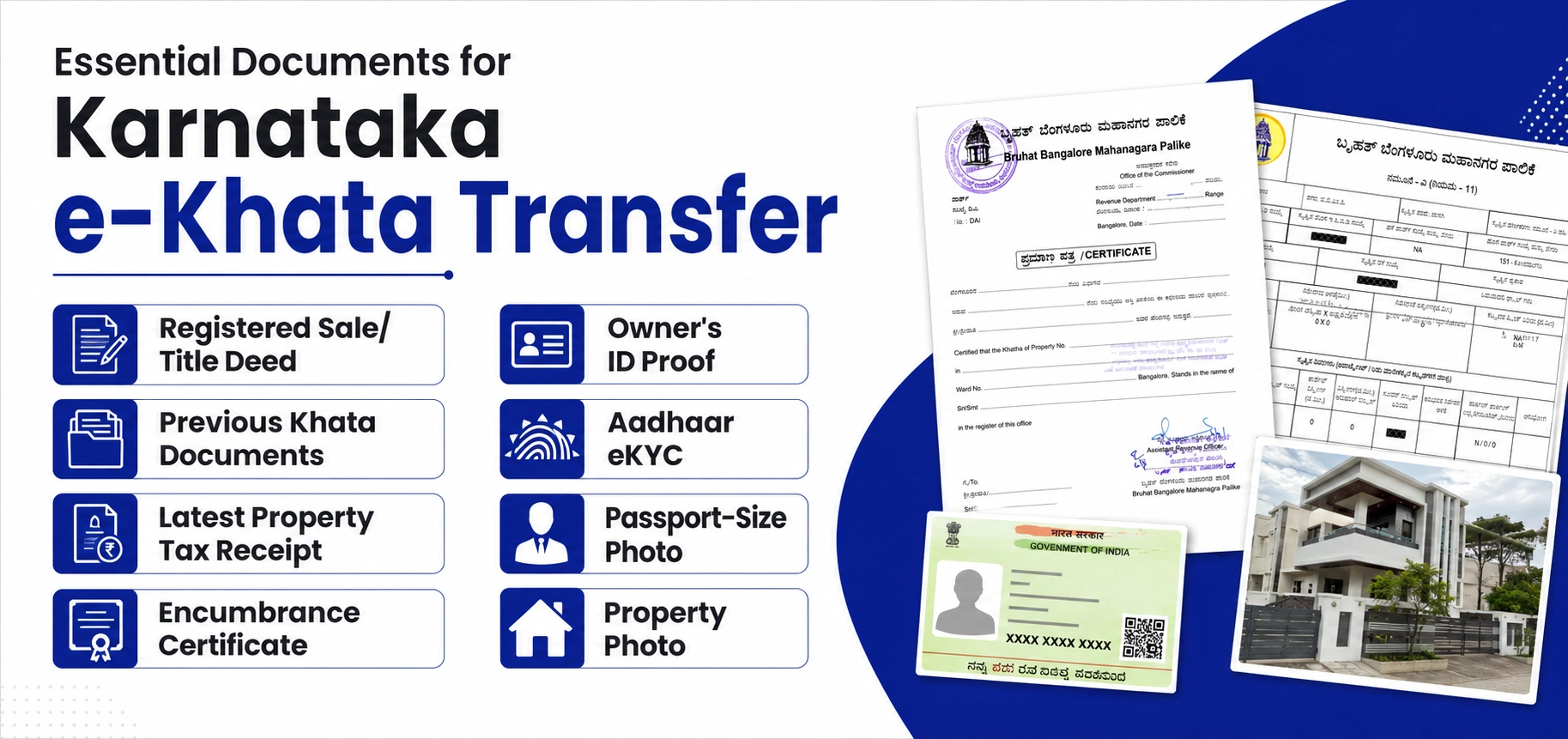
Here is a detailed list of the top 15 documents required for e-Khata transfer in Karnataka.
1. Registered Sale Deed or Title Deed
The registered sale deed is the most important document for e-Khata transfer after property purchase. It proves that the property has legally transferred from the seller to the buyer.
For other cases, the title document may be:
- Gift deed
- Partition deed
- Release deed
- Settlement deed
- Court decree
- Will-related document
- Inheritance document
- Builder sale deed
- Allotment and conveyance documents
The document should be registered and should clearly mention the property details, buyer name, seller name, sale value, schedule, boundaries, and registration details.
2. Previous Khata Certificate and Khata Extract
Previous khata certificate and khata extract help show how the property was recorded before transfer. These documents are useful for matching old municipal records with the new ownership document.
They usually contain:
- Property owner name
- Property number
- Khata number
- Assessment details
- Property location
- Built-up area or site details
- Tax assessment information
If the previous owner never updated khata, the buyer may need additional title documents and legal verification.
3. Latest Property Tax Paid Receipt
The latest property tax paid receipt is required to show that property tax has been paid up to date. Pending tax dues can delay e-Khata transfer.
Keep these ready:
- Current assessment year tax receipt
- Old tax receipts, if needed
- SAS property tax application number
- Tax payment challan
- Payment proof, if online record is not updated
Before applying for e-Khata transfer, check whether there are any pending dues, penalty, interest, or payment mismatch.
4. Encumbrance Certificate
An Encumbrance Certificate, commonly called EC, shows registered transactions related to the property for a selected period. It helps check whether the sale, gift, release, mortgage, or other registered transaction appears in official records.
For e-Khata transfer, EC may help verify:
- Ownership transfer
- Registered sale deed details
- Mortgage or loan entries
- Past property transactions
- Transaction continuity
- Legal document link
For immediate sale or transfer cases, EC becomes especially important because buyers, sellers, and authorities may use it to match registration and property records.
5. Identity Proof of Owner or Joint Owners
The applicant must provide identity proof. If the property has joint owners, ID proof of all owners may be needed.
Commonly accepted identity documents may include:
- Aadhaar card
- PAN card
- Voter ID
- Passport
- Driving license
- Ration card, where accepted
- Other government-issued ID proof
The name in ID proof should match the registered deed. If there is a spelling mismatch, keep an affidavit or correction document ready.
6. Aadhaar eKYC
For digital e-Khata processes, Aadhaar-based eKYC may be required. Aadhaar eKYC helps verify the identity of the owner or applicant through OTP or authentication.
Before applying, check:
- Aadhaar number
- Registered mobile number
- OTP access
- Name spelling
- Date of birth details
- Mobile network availability
If the Aadhaar-linked mobile number is inactive, update it before starting the e-Khata transfer process.
7. Passport-Size Photo of Owner or Joint Owners
A passport-size photo of the property owner may be required in the e-Khata application. If there are joint owners, photos of all joint owners may be needed.
Make sure the photo is:
- Clear
- Recent
- Properly scanned
- Not blurred
- Matching the applicant’s identity
A small upload error can delay the application if the photo is not accepted.
8. Property Photo
A clear property photo may be required to support property identification. This helps the local authority connect the record with the actual property.
For apartments, upload a photo of the building, flat entrance, or property as required by the portal. For plots or houses, upload a clear front-side photo or property image.
The property photo should be:
- Clear and recent
- Properly visible
- Related to the actual property
- Not edited misleadingly
- Uploaded in the required format
9. SAS Property Tax Application Number
For BBMP/GBA properties, the SAS property tax application number is often important for locating property tax records and linking them with e-Khata.
This number helps identify:
- Existing tax record
- Property tax history
- Owner details in tax records
- Property location
- Assessment record
If you do not know the SAS number, check old tax receipts or ask the previous owner before applying.
10. A-Khata Proof or Existing Khata Record
If the property is already an A-Khata property, you may need proof of A-Khata status. This helps avoid confusion between A-Khata and B-Khata records.
A-Khata proof may include:
- Previous A-Khata certificate
- Khata extract
- BBMP/GBA record
- Assessment register extract
- Tax receipt linked with khata
- Supporting municipal document
Do not claim A-Khata status unless documents clearly support it.
11. Building Plan Approval or Layout Approval
For constructed properties, layout sites, villas, or apartments, building plan approval or layout approval may be required in some cases.
This may include:
- Approved building plan
- Sanctioned plan
- Layout approval
- BDA approval
- BMRDA approval
- Local planning authority approval
- Gram panchayat approval, where applicable
These documents are useful when the authority wants to verify that the property is legally approved and properly recorded.
12. Occupancy Certificate or Completion Certificate
For apartments and larger buildings, an Occupancy Certificate or Completion Certificate may be needed to support property record updates.
These documents help show:
- Building completion
- Approval compliance
- Fitness for occupation
- Builder compliance
- Unit-level property record support
For newly purchased flats, ask the builder or association for OC, CC, and unit-wise property documentation.
13. No Objection Certificate or No-Dues Certificate
A No Objection Certificate or no-dues certificate may be required depending on property type and transfer situation.
It may be needed from:
- Apartment association
- Builder
- Bank
- Society
- Housing board
- Development authority
- Co-owner or legal heir
- Previous loan provider
A bank NOC is especially important if the property was under loan and the mortgage has been closed.
14. Death Certificate and Legal Heir Documents
If e-Khata transfer is due to inheritance after the death of the owner, extra documents are needed.
These may include:
- Death certificate of previous owner
- Legal heir certificate
- Family tree certificate
- Affidavit from legal heirs
- NOC from other heirs
- Will, if available
- Probate, where required
- Release deed, if heirs transfer rights
- Court order, if applicable
Inheritance-based khata transfer should be handled carefully because family disputes can create legal complications.
15. Power of Attorney, If Applicable
If the owner is not personally applying and someone else is acting on their behalf, a valid Power of Attorney may be needed.
Check whether the POA is:
- Properly executed
- Registered, where required
- Specific to property matters
- Valid on the application date
- Accepted by the concerned authority
For NRIs or owners living outside Karnataka, POA documentation should be reviewed carefully before use.
Documents Required Based on Transfer Type
e-Khata Transfer After Sale Deed
For transfer after sale, keep:
| Registered sale deed | Previous khata certificate/extract | Latest tax paid receipt |
| EC | Buyer ID proof | Aadhaar eKYC |
| Property photo | Owner photo | A-Khata proof, if applicable |
e-Khata Transfer After Gift Deed
For gift-based transfer, keep:
|
Registered gift deed |
Donor and donee ID proof |
Previous khata record |
|
Tax paid receipt |
Family relationship proof, if needed |
Property photo |
|
Aadhaar eKYC |
EC |
e-Khata Transfer After Inheritance
For inheritance-based transfer, keep:
|
Death certificate |
Previous khata record |
Release deed, if applicable |
|
Legal heir certificate |
Tax paid receipt |
Court order, if applicable |
|
Previous title deed |
NOC from legal heirs |
Applicant ID proof |
e-Khata Transfer After Partition
For partition-based transfer, keep:
|
Registered partition deed |
Tax paid receipt |
ID proof of parties |
|
Family tree, if needed |
EC |
Property schedule details |
|
Previous khata records |
Supporting revenue or municipal records |
e-Khata Transfer for Apartment or Flat
For flat transfer, keep:
|
Registered sale deed |
OC or CC, if required |
EC and ID proof |
|
Previous owner khata record |
Builder NOC, if applicable |
Property photo |
|
Latest tax receipt |
Flat details and schedule |
Association no-dues certificate |
e-Khata Transfer for Plot or Site
For plot transfer, keep:
|
Registered sale deed |
Layout approval |
Previous khata record |
|
Tax paid receipt |
Survey/site details |
Property photo |
|
Conversion order, if applicable |
A-Khata proof, if applicable |
EC and ID proof |
Step-by-Step Process for e-Khata Transfer in Karnataka
Step 1: Collect Property Documents
Collect the sale deed, previous khata, tax receipt, EC, ID proof, property photo, and supporting documents based on the transfer type.
Step 2: Check Name and Property Details
Compare owner name, property number, khata number, PID/ePID, site number, flat number, survey number, boundaries, and measurement across all documents.
Step 3: Clear Property Tax Dues
Before applying, check property tax status and clear pending dues. Keep the latest tax paid receipt ready.
Step 4: Complete Aadhaar eKYC
For online e-Khata systems, complete Aadhaar-based verification using the owner’s registered mobile number.
Step 5: Upload Documents
Upload clear copies of required documents in the correct format. Blurred, incomplete, or wrong files can lead to rejection or delay.
Step 6: Track Application Status
Track the application online or through the concerned local authority. Respond quickly if any clarification or additional document is requested.
Step 7: Download or Collect Updated e-Khata
After approval, download the final e-Khata or collect the updated khata record depending on the authority process.
For a more detailed process, read: How to apply for BBMP e-Khata online in Bangalore
Special Note for Bangalore Property Owners
For properties under BBMP/GBA limits, e-Khata records are closely linked with digital property tax and e-Aasthi systems. Buyers and sellers in Bangalore should check:
- BBMP/GBA e-Khata
- SAS property tax number
- PID/ePID
- Latest tax receipt
- Registered deed
- Aadhaar eKYC
- Property photo
- EC, especially when sale or transfer is planned
- A-Khata proof, if applicable
- Existing khata extract
Before selling a property in Bangalore, owners should fix e-Khata errors early to avoid registration delays.
Common Mistakes to Avoid During e-Khata Transfer in Bangalore
Avoid these mistakes during e-Khata transfer:
- Applying without checking property tax dues
- Uploading unclear documents
- Ignoring name mismatch
- Not checking EC
- Using wrong PID or SAS number
- Not completing Aadhaar eKYC
- Missing legal heir documents
- Not keeping previous khata records
- Relying only on broker advice
- Not tracking application status
- Ignoring portal objections
- Claiming A-Khata without proof
A clean document file improves the chance of smooth processing.

Leave A Comment